
Almost nobody quits fitness because of one missed workout. They quit because of what they tell themselves afterward. The session becomes proof that the plan is broken, the broken plan becomes permission to stop, and a skipped Tuesday becomes a skipped month. The collapse is psychological, and it starts with a framing error.
You didn't fail. A day went differently than expected. The useful question isn't "why did I miss it?" That mostly produces guilt and circular thinking. The useful question is: what's the best version of the rest of this week from here?
The week is the unit, not the day
One missed workout in a month of consistent training has a negligible impact on any outcome that matters. Muscle isn't lost. Fat isn't gained. The needle moves so little it's statistically swamped by normal variation in how your body responds day-to-day. That is just true.
What matters is whether the miss turns into two misses, then a week off, then a month of quiet inertia. The outcome of a missed workout isn't determined by the workout. It's determined by what you do in the next 48 hours.
Three good responses to a missed workout
There are three sound options when you miss a session. Which one fits depends on your timing and honest self-assessment.
Compress. If the day isn't fully gone and you have 15–25 minutes, do a shortened version of the planned session. Prioritize the compound movements (squat, press, pull) and cut the accessories. A tight 20-minute session preserves meaningful training stimulus and, more importantly, preserves momentum. WorkoutPal has a one-tap option to request a 20-minute version of any planned workout. It trims intelligently around the session's structure rather than just cutting a timer short.
Reschedule. If the day is genuinely gone but the rest of the week has room, shift the session forward by a day and re-sequence from there. Commit to the replacement slot the same way you'd block a meeting. WorkoutPal handles the logistics: it adjusts surrounding training days so recovery intervals stay sensible and you're not stacking two hard sessions back-to-back by accident.
Genuine rest. If you're sick, running on four hours of sleep, or in the middle of an unusually demanding stretch at work, treating the day as intentional rest is the right call. Training in that state carries real costs: slower recovery, lower output quality, elevated injury risk. Recognizing when rest is the right input protects the next four sessions more than forcing a bad one today.
Why doubling up tomorrow is almost always wrong
The instinct to make up a missed session by doing twice as much the next day is strong and almost always backfires.
Two hard sessions back-to-back typically produce lower quality output on the second day, more soreness, and a higher chance of a third miss. You end up doing three substandard sessions while chasing one missed one. The week does not end ahead; it ends behind.
Fitness training isn't a debt ledger. You don't owe yesterday's session to tomorrow. Missing one in a month of consistent work won't affect your results in any meaningful way. Grinding through a fatigued double-session might.
How to recover the week: scenario guide
| Situation | Best move |
|---|---|
| Missed Monday in a Mon/Wed/Fri plan | Compress Monday evening if any time remains; shift to Tuesday otherwise. Move Wed/Fri to Thu/Sat. Week intact. |
| Missed Wednesday in a Mon/Wed/Fri plan | Shift to Thursday. Friday stays. Two sessions in the week is a fine result. |
| Missed Friday (last session of week) | Let it go. Start the next week clean rather than forcing a tired weekend session. |
| Missed two or more sessions in one week | Re-evaluate the schedule, not the discipline. Either the programme volume doesn't match your real life, or this was an unusually difficult week. Both are fixable. |
| Sick or seriously sleep-deprived | Genuine rest. One or two full rest days followed by a normal return beats training through illness or severe fatigue. |
Nutrition on a missed training day
You probably don't need to change much.
For most people training three to five times a week, the calorie difference between a training day and a rest day is smaller than it feels. Chasing it with major food adjustments adds friction without meaningful benefit. Keep your protein target the same: muscle protein synthesis doesn't switch off because you skipped a session. If you want to trim calories slightly, a smaller dinner or cutting an evening snack is usually enough adjustment.
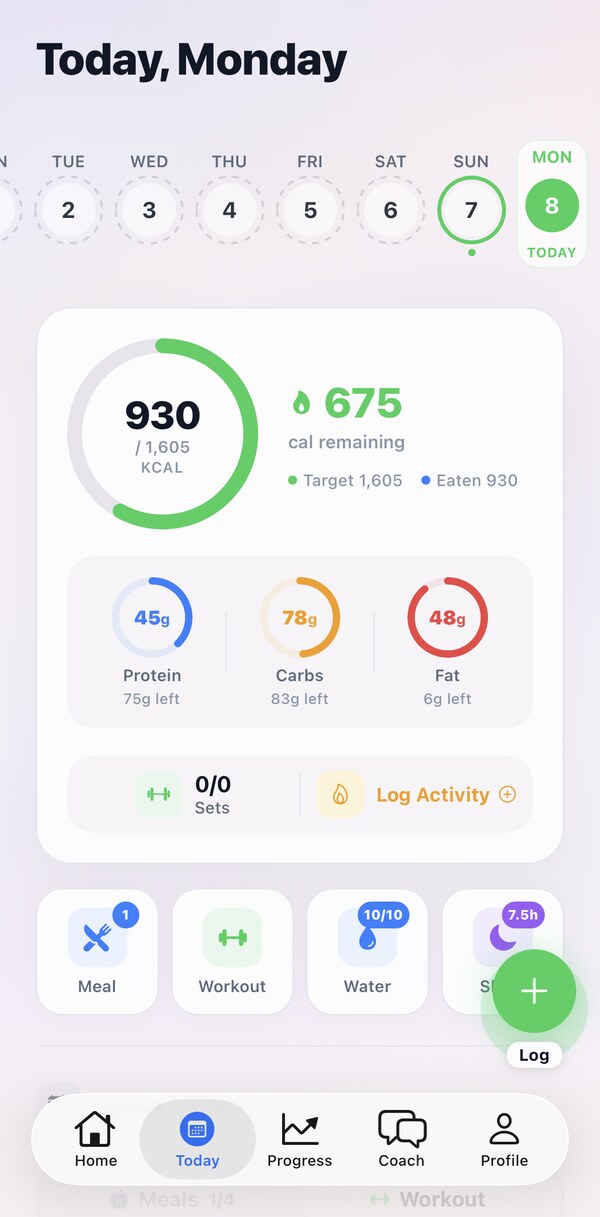
In WorkoutPal, swapping a meal or logging a change updates the rest of the day automatically. You don't have to work out the math manually.
When missed sessions are a pattern, not a one-off
One missed workout is a data point. Five missed workouts in a month is a signal about your schedule or your programme.
If you consistently miss the same training day each week, that day probably doesn't fit your life. Move the session to a slot you'll actually show up for. If you're missing because the programme feels like too much, reduce the volume to something sustainable before you burn out and drop it entirely. A lighter programme you stick with for six months beats a perfect one you abandon in six weeks.
For the broader question of why fitness plans break and how to build ones that don't, see why fitness tracking apps don't change behavior.
Frequently asked questions
Does missing one workout affect muscle growth?
No, not meaningfully. One missed session has negligible impact on muscle protein synthesis or strength progression over a week or month. Consistent training with occasional misses outperforms a perfect programme that eventually gets abandoned.
Should I do a longer workout to make up for a missed session?
No. Stacking two hard sessions back-to-back usually produces lower quality output and more soreness, which can compromise the session after that too. Compress or reschedule instead.
How many workouts can you miss before losing fitness?
Meaningful detraining takes longer than most people expect. Cardiovascular fitness starts to decline after roughly two weeks of complete inactivity; strength takes longer, typically three to four weeks without any training. Missing a session, or even a full week, does not trigger detraining.
What should I eat on a day I missed my workout?
Keep protein the same and make modest calorie adjustments if you want to, typically a smaller dinner or removing an evening snack. Don't overhaul your nutrition around a single missed session. Protein supports muscle recovery regardless of whether you trained that day.
Let the plan do the rescheduling for you
Everything above is a set of decisions: compress or reschedule, which day to move to, how to keep recovery sensible, what to do with the rest of the week. Making those calls by hand is exactly the friction that turns one missed session into a missed month. The point of an adaptive app is to take that load off you.
WorkoutPal does the re-sequencing automatically. Tell it you missed today and it rebuilds the week around the days you have left, keeping rest between hard sessions intact instead of stacking two on top of each other. Short on time rather than skipping? Ask for the twenty-minute version of any workout and it trims to the movements that matter. Off on nutrition because the day went sideways? Swap a meal and the remaining targets rebalance. You are never left staring at a broken schedule trying to repair it yourself.
Why a free, complete plan makes recovery stick
Consistency is the only variable that reliably predicts results, and consistency is mostly about how easily you can get back on track after a bad day. That gets much easier when the plan is built for your actual life from the start. With WorkoutPal you answer a few questions about your goal, your schedule, and your preferences, and in about a minute you have a complete, personalized workout and meal plan to follow, free.
It is completely free to use, with no paywall, so a rough week never costs you anything except the session you missed. You reopen the app, take the next action it gives you, and the week keeps moving. That is the difference between a plan that breaks and a plan that bends.
A plan that bends instead of breaking
WorkoutPal adjusts your week when life gets in the way: 20-minute workouts on demand, one-tap reschedule, or a full replan in seconds. Free on iPhone.
Download free on the App Store