Most fitness tracking apps are solving the wrong problem. They are built to record every calorie, every rep, every missed run. What they cannot do is show up at 6:45am when you are running late and tell you what to do. That part is still entirely yours.
Logging is useful context. The problem is that behavior happens now, and a log shows you yesterday. Most apps hand you a detailed record of the past and leave the present entirely to you, which is where almost every fitness effort falls apart.
Decision fatigue is a real tax on fitness tracking
Every time you open a tracking app, it asks you to make a judgment call. Was that a medium portion or a large one? Is today a training day? Should you double up tomorrow because you missed Monday, or reset and start fresh? Each call feels small.
Pile them up over a month and they're exhausting. Exhausted people fall back on their defaults, which is the exact thing you downloaded the app to change.
The research on habit formation points consistently in one direction: fewer decision points mean better follow-through. The most effective coaching removes choices rather than multiplying them. It says: do this thing, now, in the time you have.
Dashboards describe. The best fitness habit apps prescribe.
There's a clean distinction between descriptive tools and prescriptive ones. A descriptive tool tells you what happened. A prescriptive one tells you what to do next: one clear recommendation that fits where you are right now.
Most fitness tracking apps are sophisticated mirrors. They reflect your behavior with impressive clarity: charts, streaks, weekly summaries, macro breakdowns. That reflection can be motivating for a few weeks. Then comes the bad Wednesday: short on sleep, poorly-fed, nothing logged, and the mirror just shows you a dashboard full of red numbers. It doesn't know what to do about that. It keeps reflecting.
A prescriptive system doesn't wait. It looks at your current week, what you've eaten, the time you have, and figures out the best version of today from here.
Rigid plans snap
Most fitness programmes assume a perfect week. Monday is free, Wednesday is free, you'll sleep fine and feel motivated. They're optimized for a version of your life that exists occasionally.
First time Monday goes wrong, the plan has no response. It sits there, off-track, while you decide whether to double up on Tuesday or quietly drop the whole thing. Most people choose the latter, not from lack of discipline, but because the plan gave them no graceful exit from an imperfect day.
Elastic plans bend. Miss a session and the week reshapes around it. Eat differently than planned and the remaining meals adjust. The goal isn't a perfect record; it's momentum that survives a bad week, which is most weeks for most people.
What elastic planning actually looks like
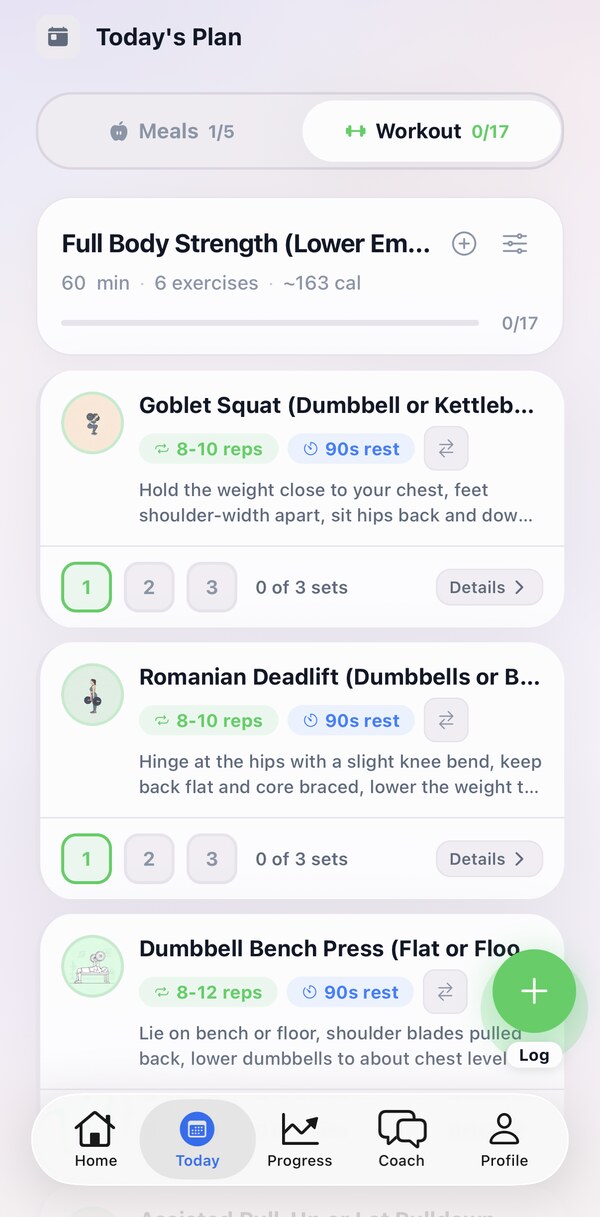
An elastic plan isn't a vague plan. It has structure: set-by-set workouts with weights, reps, and progression built over weeks, meals planned around your macro targets, measurable outcomes. The elasticity shows when something changes.
Twenty minutes instead of an hour? The workout compresses around the compound movements and drops the accessories. Swapping a lunch you don't want? The day's macros stay intact. Missed a training day? The week re-sequences so recovery between sessions stays sensible. None of this requires you to hold the logic in your head. That's the point.
The AI coach that acts instead of answering
Almost every fitness app has a chat interface now. Most of them answer fitness questions reasonably well. Ask about protein requirements, get a number. Ask about exercise alternatives, get a list. Useful. Not coaching.
Coaching means taking action. WorkoutPal's AI coach edits your plan. Tell it you missed a session and it reschedules the week. Tell it you only have 20 minutes and it rebuilds the workout on the spot. Swap a meal and the day rebalances so your protein target stays intact. Ask it to build a grocery list from your week's meals and it does. It can adjust calories after an energy check-in, or lighten a heavy training week when you're running low.
An app that does things is different from one that tells you things. That difference shows up every day.
The only metric that actually matters for fitness
Fitness outcomes come down to one variable: how many weeks you keep showing up. One perfect week in month three doesn't undo twelve months of consistency. One bad week in a solid year barely matters.
Apps that lower the friction of showing up on a difficult day are doing the more important work, even if their dashboards are less impressive. A beautiful macro breakdown that causes you to quit in week five is worse than a rough adaptive plan you stick with for eighteen months.
For a concrete look at this applied to a specific scenario, see how to recover after a missed workout.
Frequently asked questions
Why don't fitness tracking apps work long-term?
Most tracking apps record data but don't reduce the decisions you have to make. After the novelty fades, daily logging becomes another obligation without clear payoff. Apps that stick long-term either remove friction or give you a clear next action, ideally both.
What makes a fitness app actually change behavior?
Three things: it removes decisions by telling you what to do next (not just what you did yesterday), it adapts when the plan breaks rather than leaving you stranded on an off-track week, and it lowers the cost of an imperfect day so one bad session doesn't spiral into a month off.
What's the difference between a fitness tracker and a fitness habit app?
A tracker records what you did. A habit app is prescriptive: it tells you what to do and adjusts based on how your week is going. The data is a means to that recommendation, not the product itself.
Do I need to track every calorie to see fitness results?
No. Tracking is a tool, not a requirement. It's most useful when you're hitting a specific macro target like daily protein, or understanding your calorie baseline. A structured adaptive plan with meal guidance closes the gap for many people without obsessive logging.
What a plan that adapts actually looks like
The alternative to a dashboard is not more discipline. It is a smaller decision. WorkoutPal builds one plan for the day and points at the next thing on it: this workout, these meals, this much protein left to hit. When the day changes, the plan changes with it. Miss a session and the week re-sequences. Eat off plan and the remaining meals rebalance. You are never staring at a record of what went wrong, because the system has already moved on to what to do next.
That shift, from describing your past to directing your present, is the whole reason behavior changes. A tracker asks you to be your own coach after a long day. An adaptive plan does the coaching for you and leaves you one clear action.
Why one connected system beats five separate apps
Most people end up running a workout app, a calorie counter, a recipe app, a notes file, and an AI chatbot that knows none of it. Each one is a silo, and you become the integration layer, copying numbers between them at the exact moment you are least motivated to. The friction is the failure.
WorkoutPal keeps workouts, meals, protein and calorie targets, recovery, and an AI coach inside a single plan that updates together. Because the coach can see the whole picture, asking it to shorten today to twenty minutes or swap a meal does not break anything downstream; the rest of the day adjusts to keep your targets intact. One system, one source of truth, one next action.
Completely free, and set up in about a minute
The honest blocker for most fitness apps is the paywall: you answer a quiz, get shown a plan, then hit a subscription screen before you can use it. WorkoutPal is free to use. Not a seven-day trial, not a locked preview, not the good features held back for premium. You answer a few questions about your goal, your lifestyle, and your preferences, and in about a minute you have a complete, personalized workout and meal plan built around them, ready to follow that day at no cost.
That matters for behavior change specifically, because the thing that predicts results is not the perfect program. It is how many weeks you actually show up. An app you can start in a minute and keep using for free removes the two biggest reasons people quit before they begin.
Get your free plan in about a minute
Answer a few questions about your goal, lifestyle, and preferences, and WorkoutPal builds a complete, personalized workout and meal plan in about a minute. It tells you what to do next and reworks the plan when your day changes. Completely free, no paywall.
Download free on the App Store