Almost every fitness app now says it uses AI. The useful question is not whether an app has AI, but what the AI actually does. Some generate a workout, some adjust your numbers, and a few change your whole plan when your day falls apart. We compared the leading AI fitness apps and ranked them by how much the AI really does for you.
How we judged the AI
We looked past the marketing and rated each app on what its AI genuinely delivers:
- Does it generate or just answer? Building a real workout beats a chatbot that only explains things.
- Does it adapt? The best AI changes future sessions based on your performance, recovery, and schedule.
- Does it take action? Applied AI makes a real change to your plan in a tap, rather than handing you advice to implement yourself.
- How wide is its scope? Some AI touches only workouts. The strongest reaches across workouts, nutrition, and recovery together.
- Value and platform: price, free tier, and availability on iPhone and Android.
The best AI fitness apps at a glance
| App | Best for | What the AI does | Price (2026) |
|---|---|---|---|
| WorkoutPal | Applied AI across your whole day | Takes actions: swaps meals, shortens workouts, rebalances the day | Free to start |
| Fitbod | AI strength training | Generates equipment and recovery-aware lifting | ~$12.99/mo or ~$79.99/yr |
| Freeletics | AI bodyweight training | Adapts sessions from your feedback | Bundles from ~$34.99 |
| FitnessAI | AI progressive overload | Optimizes sets, reps, and weight from data | Subscription, varies |
| JuggernautAI | AI for powerlifting | Periodized strength programming | Subscription, varies |
| Zing Coach | AI fitness assessment | Assesses level and builds adaptive plans | Subscription, varies |
| Future | Human coach plus software | AI supports a real coach | Premium, around $150+/mo |
1. WorkoutPal: best applied AI coach
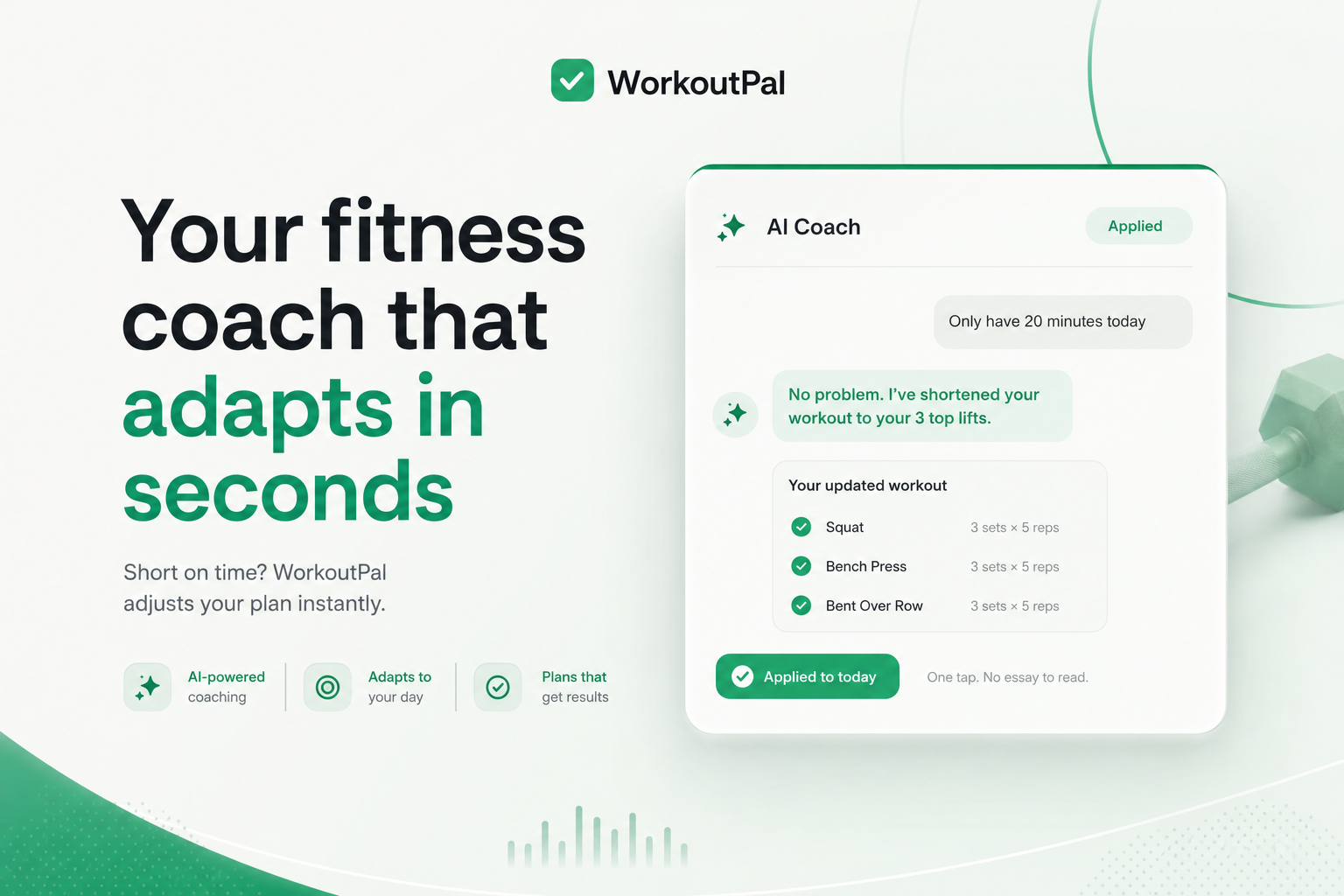
Most AI fitness apps use AI to build a workout. WorkoutPal uses it to run your day. That is the distinction that matters. Its coach is applied rather than informational, which means that when you ask for help, you get an action, not an explanation. Ask to make today easier and it shortens the session to the highest-value work. Tell it you ate off-plan and it rebalances the rest of your day. Need food sorted and it builds a grocery list from your plan. Miss a session and it converts a lost day into a recoverable one.
The scope is the other differentiator. Most AI in this category touches only training. WorkoutPal's reaches across workouts, meals, and recovery at once, so a change in one place updates the others. For someone who wants an AI that behaves like a coach managing the whole picture, rather than a smart workout generator, this is the standout.
Best for: people who want AI that takes real actions across training, nutrition, and recovery.
Strengths: applied, action-taking coach, whole-day adaptivity, one connected system, one-tap changes.
Trade-offs: newer than the specialists here, and not aimed at competitive powerlifting programming specifically.
Platform and price: iPhone and Android, free to start. Download WorkoutPal on the App Store.
2. Fitbod: best AI for strength training
Fitbod's AI generates each strength session from your history, available equipment, and muscle recovery, so your workout reflects where you are today. It is polished, well-rated, and excellent at its one job.
Best for: lifters who want smart, ready-to-go strength workouts.
Strengths: recovery-aware generation, large exercise library, clean experience.
Trade-offs: the AI stays within workouts and does not manage nutrition or your whole day.
3. Freeletics: best AI for bodyweight training
Freeletics uses its Coach to build no-equipment workouts and refine future sessions from your post-workout feedback. The more honestly you rate a session, the better the programming gets.
Best for: home and travel training with no equipment.
Strengths: feedback-driven adaptation, variety, works anywhere.
Trade-offs: narrower for barbell strength, and not a nutrition system.
4. FitnessAI: best AI progressive overload
FitnessAI focuses on optimizing sets, reps, and weight for each lift using data from millions of logged workouts. If you want the AI to manage your numbers session to session, it is a strong specialist.
Best for: lifters who want data-driven load progression.
Strengths: automated overload, simple to follow.
Trade-offs: narrow focus on lifting numbers, limited beyond that.
5. JuggernautAI: best AI for powerlifting
Built by a respected strength coach, JuggernautAI generates periodized programs tuned to your competition goals, weak points, and training history. For serious barbell athletes, its depth is hard to match.
Best for: powerlifters and strength athletes.
Strengths: periodization, individualization, expert pedigree.
Trade-offs: specialized for competitive lifting, not general fitness or nutrition.
6. Zing Coach: best AI fitness assessment
Zing Coach starts by assessing your fitness level, then builds and adapts a plan around it. Its assessment-first approach appeals to people who want the AI to meet them where they are.
Best for: beginners and returners who want a level-matched plan.
Strengths: onboarding assessment, adaptive plans.
Trade-offs: training-centric, less about whole-day coaching.
7. Future: best human coaching supported by software
Future is not really an AI-first app. It pairs you with a real certified coach, using software to support the relationship. If you want a human in your corner and can pay for it, that human touch is its own advantage.
Best for: people who want genuine human accountability.
Strengths: real coach, weekly personalization, motivation.
Trade-offs: premium price, and the intelligence is mostly human rather than automated.
What "AI" should actually mean in a fitness app
The gap between these apps is not whether they use AI, but how far the AI reaches. A chatbot that answers questions is the shallow end. A generator that builds a workout is better. An engine that adapts future sessions is better still. The deepest version is an applied coach that takes action across your entire day, training, nutrition, and recovery, and changes the plan when real life interferes. That last category is where WorkoutPal is built to lead, while the specialists above are excellent within their narrower lanes.
Frequently asked questions
What is the best AI fitness app in 2026?
It depends on what you want the AI to do. For an applied AI coach that takes real actions across workouts, meals, and recovery and adapts your whole day, WorkoutPal is our pick. For AI strength training, Fitbod leads, for AI bodyweight training, Freeletics, and for AI powerlifting programming, JuggernautAI.
What is the difference between a fitness chatbot and an applied AI coach?
A fitness chatbot answers questions and gives advice you then have to act on. An applied AI coach makes the change for you, such as shortening a workout, swapping a meal, or rebalancing your day in a single tap. WorkoutPal is built around applied, action-taking AI.
Which AI fitness app adapts to missed workouts?
WorkoutPal is designed to convert a missed session into a recoverable day by shortening, rescheduling, or redistributing the work. Freeletics and Fitbod adapt future workouts based on performance and recovery, though within training rather than across your whole day.
Are AI fitness apps as good as a personal trainer?
For programming, progression, and daily guidance, good AI apps now do a lot of what a trainer does at a fraction of the cost. For hands-on form correction and human accountability, a real coach, or a hybrid service like Future, still has an edge. Many people combine an adaptive app with occasional human input.
Is there a free AI fitness app?
WorkoutPal is free to start. Most dedicated AI training apps, including Fitbod, Freeletics, and Future, are primarily paid, though several offer trials.
References
- App Store and Google Play listings for each app (features, pricing, ratings), 2026
- Fitbod and Freeletics product pages (AI generation and adaptation)
- FitnessAI and JuggernautAI product descriptions (progression and periodization)
- Independent 2026 AI fitness app reviews for comparison context
- WorkoutPal product features (applied AI coach, whole-day adaptivity)
Prices, ratings, and features are current as of 2026 and change frequently. Confirm the latest on each app's official store listing. This article is general information and not medical advice.
Get coaching that adapts to your week
WorkoutPal is free on iPhone. Build a personalized plan in under a minute, then watch it adjust the moment your day changes.
Download free on the App Store