There is no single best fitness app, only the best one for how you actually train and eat. We put the leading options through the same set of criteria and sorted them by the job each one does best. This guide covers what each app is genuinely great at, where it falls short, what it costs, and who should download it.
How we evaluated these apps
We judged each app on the same seven criteria, based on hands-on use and each product's published features:
- Guidance: does it tell you what to do next, or just record what you did?
- Adaptivity: when a workout is missed, a day runs short, or you eat off-plan, does the plan adjust?
- Integration: do workouts, nutrition, and recovery talk to each other, or live in separate silos?
- Usefulness of AI: does the AI take real actions, or mostly answer questions?
- Consistency: how well does it help an ordinary, busy person actually keep going?
- Value and platform: price, free tier, and availability on iPhone and Android.
- Depth: food database, exercise library, and integrations, where that depth matters.
The best fitness apps in 2026 at a glance
| App | Best for | Platform | Price (2026) |
|---|---|---|---|
| WorkoutPal | An adaptive, all-in-one daily plan (workouts, meals, recovery, AI coach) | iPhone, Android | Free to start |
| MyFitnessPal | Deep nutrition and calorie tracking | iPhone, Android | Free; Premium from ~$19.99/mo |
| Fitbod | AI-generated strength training | iPhone, Android | ~$12.99/mo or ~$79.99/yr |
| Freeletics | Bodyweight and no-equipment training | iPhone, Android | Bundles from ~$34.99 |
| Future | One-on-one human coaching | iPhone, Android | Premium, around $150+/mo |
| Strava | Running and cycling | iPhone, Android | Free; Premium ~$11.99/mo |
| Hevy | Simple gym logging with a social feed | iPhone, Android | Free; Pro available |
1. WorkoutPal: best all-in-one adaptive daily plan
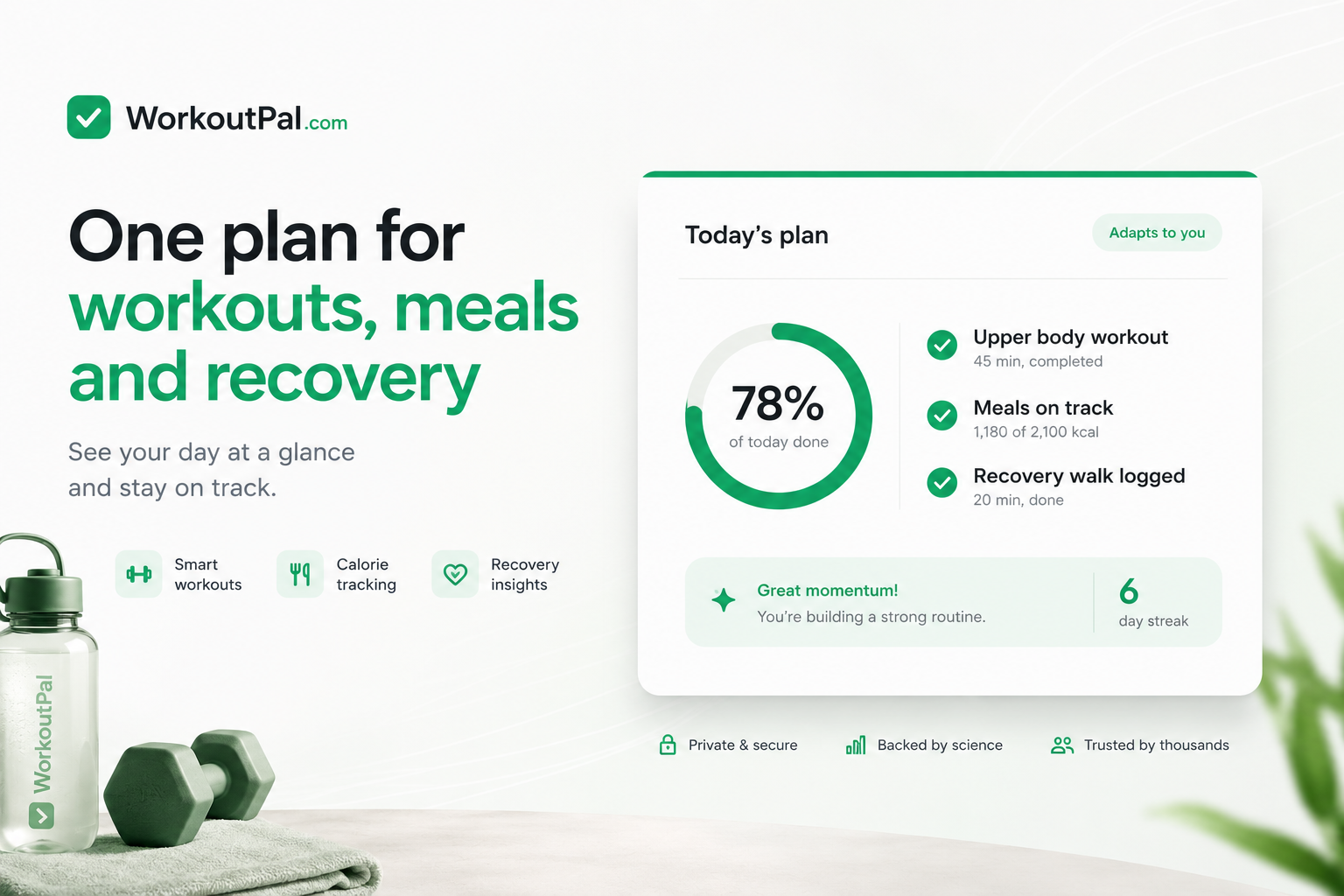
Most fitness apps are trackers. They are very good at recording what already happened, and they leave the thinking to you. WorkoutPal is built around a different idea: open it, see the one thing that matters right now, and let the plan reorganize itself when your day does not go to script.
That is the real difference. If you miss a workout, WorkoutPal offers a shorter version or rebalances the week instead of leaving a red gap on a calendar. If you eat off-plan, it adjusts the rest of the day rather than just logging the damage. On a rest day, it shifts you toward recovery and light activity. The AI coach is applied rather than informational, so asking for help produces an actual change to your plan, swapping a meal, shortening a session, building a grocery list, rebalancing macros, in a tap, not an essay you then have to act on yourself.
Best for: people who struggle with consistency and want one system that guides the whole day instead of five apps they have to coordinate.
Strengths: genuine next-step guidance, adaptive "save the day" logic, workouts and nutrition and recovery in one connected loop, a modern and calm interface.
Trade-offs: it is newer than the established names here, so it does not yet carry their decade-long track record or their largest-in-class food database.
Platform and price: iPhone and Android, free to start. Download WorkoutPal on the App Store.
2. MyFitnessPal: best for deep nutrition tracking
MyFitnessPal remains the reference point for calorie and macro logging. Its food database is one of the largest available, with well over 14 million entries, and its barcode scanner, voice logging, and meal scan make logging fast. With a community numbering in the hundreds of millions and integrations across Apple Health, Google Fit, Fitbit, Garmin, and Strava, it is the safe default if nutrition tracking is the center of your routine.
Best for: detailed food logging and people who want a huge database and broad device sync.
Strengths: database size, logging speed, integrations, maturity and trust.
Trade-offs: it is tracking-first, so it tells you what happened more than what to do next, and workouts, meals, and recovery do not adapt to each other. Several once-free features now sit behind Premium.
3. Fitbod: best for AI strength training
Fitbod generates strength workouts from your history, available equipment, and muscle recovery, so each session reflects where you are now. With a library of more than 1,000 exercises and a strong App Store rating, it is the pick if progressive, equipment-aware lifting is your main goal.
Best for: gym-goers focused on structured strength progression.
Strengths: smart workout generation, recovery-aware muscle targeting, clean logging.
Trade-offs: it is a workout app, so nutrition and whole-day guidance are not its job.
4. Freeletics: best for bodyweight and no-equipment training
Freeletics builds high-intensity workouts you can do anywhere, adjusting future sessions based on your feedback. With hundreds of exercises and a large global user base, it is the strongest option for training without a gym.
Best for: travelers, home exercisers, and anyone who trains without equipment.
Strengths: variety, adaptivity to feedback, no equipment needed.
Trade-offs: less suited to barbell strength progression and not a nutrition hub.
5. Future: best for one-on-one human coaching
Future pairs you with a real, certified coach who programs your training, messages you regularly, and adjusts your plan each week. If accountability from an actual person is what keeps you going, and the budget is there, it is hard to beat.
Best for: people who want human accountability over algorithmic adaptation.
Strengths: genuine personalization, real relationship, weekly adjustments.
Trade-offs: the premium price is many times that of app-only options.
6. Strava: best for running and cycling
Strava is the social home of endurance sport, with rich activity tracking, segments, and a motivating community. If your training is mostly running or cycling, it is the natural fit.
Best for: runners and cyclists who want tracking plus community.
Strengths: endurance analytics, segments, social motivation.
Trade-offs: not a strength trainer or nutrition tool.
7. Hevy: best for simple gym logging
Hevy is a clean, fast workout logger with a social feed, popular with lifters who want to record sets and reps without fuss. It does one job well.
Best for: lifters who want straightforward logging and a community.
Strengths: speed, simplicity, free tier.
Trade-offs: it logs rather than guides, and does not touch nutrition or recovery.
How to choose the right fitness app
Match the tool to the problem. If your main gap is nutrition detail, MyFitnessPal or a dedicated tracker fits. If it is barbell progression, Fitbod. If it is training without a gym, Freeletics. If it is human accountability and budget is not a concern, Future. But if the real issue is consistency, the all-too-common cycle where one missed day becomes two lost weeks, an adaptive system that guides your whole day and adjusts when life gets in the way, like WorkoutPal, is built specifically for that problem.
Frequently asked questions
What is the best all-in-one fitness app in 2026?
For an adaptive, all-in-one plan that combines workouts, meals, recovery, and AI coaching and adjusts when your day changes, WorkoutPal is our pick. For nutrition depth specifically, MyFitnessPal leads, and for AI strength training, Fitbod. The best choice depends on whether you want a guided daily system or a specialized tracker.
What is the difference between a fitness tracker app and an adaptive coaching app?
A tracker records what you did, such as calories, sets, or miles, and leaves the decisions to you. An adaptive coaching app tells you what to do next and changes the plan when you miss a session, run short on time, or eat off-plan. WorkoutPal is built around this adaptive model rather than pure tracking.
Which fitness apps are free?
WorkoutPal is free to start, and Strava and Hevy offer capable free tiers. MyFitnessPal has a free version with paid Premium features. Fitbod, Freeletics, and Future are primarily paid.
Do I need separate apps for workouts and nutrition?
Not necessarily. Many people use a workout app plus a calorie tracker, but that means coordinating two tools that do not talk to each other. An integrated system like WorkoutPal keeps workouts, meals, and recovery in one place so they adjust together.
Which fitness app is best for consistency?
Consistency improves most when the app reduces decisions and helps you recover a messy day instead of abandoning the week. Apps that surface a single next action and adapt to missed sessions, such as WorkoutPal, are designed for this, while pure trackers rely more on your own motivation.
References
- App Store and Google Play listings for each app (features, pricing, ratings), 2026
- Fitbod product pages and blog (exercise library, adaptive generation)
- Freeletics product listing (exercise count, adaptive coaching)
- MyFitnessPal homepage and store listings (food database, integrations, membership)
- WorkoutPal product features (adaptive daily system, applied AI coach)
Prices, ratings, and features are current as of 2026 and change frequently. Confirm the latest on each app's official store listing. This article is general information and not medical advice.
Get coaching that adapts to your week
WorkoutPal is free on iPhone. Build a personalized plan in under a minute, then watch it adjust the moment your day changes.
Download free on the App Store