"Best free AI fitness app" is one of the most searched phrases in health tech right now, and it's being answered mostly with content that either names a ranked list without honest criteria or just routes you to whichever app sponsors the article. This is an attempt to give you something more useful: a five-point checklist you can apply to any app you're evaluating, including WorkoutPal.
First: understand what category of app you're actually looking at
The label "AI fitness app" gets applied to four genuinely different types of product. They're not interchangeable:
| Category | What it actually does | Best for | Limitation |
|---|---|---|---|
| Single-purpose workout tracker | Logs sets, reps, weights; generates basic programmes | Detailed lifting logs; powerlifters; sport-specific logging | No nutrition, no coaching, no adaptation |
| Calorie / nutrition logger | Tracks food intake, macros, calories | Food awareness; people who only want nutrition data | No workout planning, no coaching, no plan context |
| AI chatbot with fitness content | Answers fitness questions via chat | Accessible general advice | Generic responses; doesn't see your actual data |
| All-in-one adaptive coach | Plan, workouts, meals, nutrition, AI coach that edits the plan: one connected system | People who want the full picture in one place | More complex; overkill if you only need one thing |
None of these categories is categorically better. A powerlifter who wants a precise barbell log may be happier with a single-purpose tracker than with anything all-in-one. The right category depends on what you actually need from an app. Most people searching for the best free AI fitness coach app are looking for the fourth category.
Criterion 1: Does it adapt, or just track?
The most important question. A tracking app records what you did. An adaptive app changes what it recommends based on what actually happened.
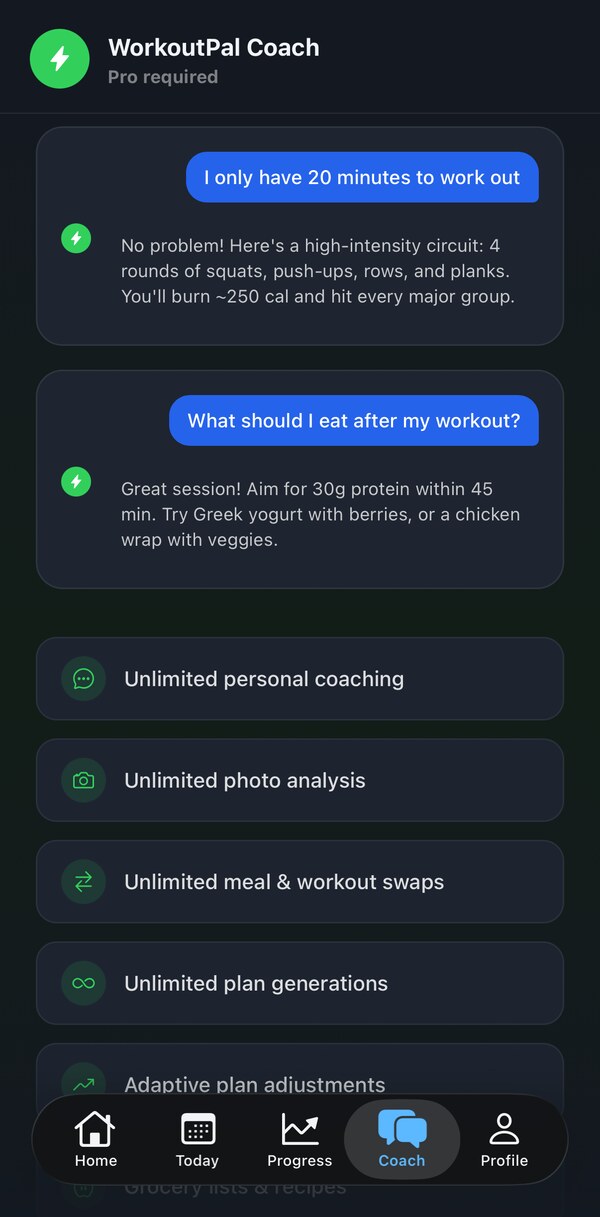
The practical test: tell the app you only have 20 minutes for today's workout. A tracker shows you the planned 60-minute session and maybe a timer. An adaptive system rebuilds the workout on the spot around the time you have. Tell it you missed Monday's session: does it reschedule the week intelligently, or just leave the missed session sitting on the calendar? Those two responses represent fundamentally different products.
Criterion 2: Do the parts connect?
Plenty of apps have both a workout module and a nutrition module. If they don't share state, you've got two dashboards, not a coaching system.
A connected system knows your training load when it sets your nutrition target. It knows what you actually ate today when it coaches you on tonight's meal. It knows your energy check-in from this morning when it decides whether to schedule a hard or easy session tomorrow. Disconnected tools can't give that kind of recommendation because none of them can see the whole picture. This is why most people who take fitness seriously end up running five apps simultaneously, and why the best all-in-one apps are specifically more valuable than the sum of five single-purpose ones.
Criterion 3: Is it honest about its estimates?
Photo calorie counting is an estimate. Apps that present photo estimates as exact figures are doing you a disservice. For whole foods on a simple plate, a good AI photo calorie counter is within roughly 10–15% of actual. For restaurant meals, variance of 25–40% is typical. The honest app surfaces this. It tells you that nutrition depends on preparation, explains where estimates are less reliable, and gives you food quality alongside the calorie number so you can make better decisions than a single ambiguous total allows.
See how AI photo calorie counting works for a detailed breakdown of accuracy by food type and the fastest logging methods for each situation.
Criterion 4: Does the coach act, or just answer?
A chat interface that answers fitness questions is now table stakes. Almost every app has one. The question worth asking: does the coach take action, or does it give generic advice?
Here's a concrete test. Tell any app: "I'm 40g short on protein and have one meal left today. What should I eat with what's probably in my kitchen?" A generic chatbot responds with a list of high-protein foods. A coaching system that knows your meal plan, your remaining macros, and your typical food preferences responds with a specific suggestion that fits your day. That specificity is what separates a real AI fitness coach from a conversational FAQ.
Real coaching actions include: shortening workouts on demand, rescheduling a missed session while keeping recovery intervals sensible, swapping a meal and rebalancing the day, building a grocery list from the week's meal plan, and adjusting intensity based on energy check-ins. If an app can't do any of those, it's a chatbot, not a coach.
Criterion 5: What does "free" actually mean?
Free tiers exist on a wide spectrum. At one end: a genuinely functional free tier where you can build a personalized plan, run a full training week, log your meals, and get at least basic coaching without a paywall. At the other: free access to almost nothing useful, with the first interesting feature behind a subscription screen.
The test: can you run your daily fitness routine (workouts, meal logging, a plan that responds when things change) for a full week without hitting a payment screen? If not, it's a trial, not a free tier.
The progress side: why it matters as much as the daily coaching
The best fitness apps treat progress as a narrative, not a ledger. Progress photos over months, weekly insights showing how this week's nutrition compared to last week's, energy and wellness check-ins that inform coaching, milestone streaks that reflect real consistency: these are signals that help you understand whether the direction is right, not just how today scored.
People stay consistent with fitness routines when they can see a trajectory. An app that shows you you're 18% stronger on squats than six weeks ago, or that your average weekly protein has risen 20g from last month, is giving you information that sustains motivation through the weeks when progress isn't visible in the mirror. The daily numbers are means. The trend is the end.
How WorkoutPal meets this checklist
WorkoutPal is built for the all-in-one adaptive coach category. On adaptivity: the daily plan updates when things change; 20-minute workouts on demand, one-tap reschedule, or a full replan via the AI coach. Workouts are set-by-set with weights, reps, rest, and auto-progression. On connected breadth: workouts, meals, nutrition targets, health scores, progress photos, and energy check-ins all share the same underlying plan, so the AI coach can give recommendations with full context.
On honest estimates: every photo log is surfaced as an estimate, each meal gets a transparent health score showing the factors behind it (fiber, added sugar, sodium, processing level), and the app never rounds a bounded estimate into a false fact. On coaching action: the AI coach edits your plan rather than just answering questions. On free access: the free tier builds a full personalized plan around your goals, schedule, and fitness level with no trial clock and no feature gate on the core loop.
For more on what separates a fitness habit app from a tracker, see why fitness tracking apps don't change behavior. For the recovery side, how to recover after a missed workout shows the elastic plan principle working in a real scenario.
Frequently asked questions
What's the best free AI fitness app in 2026?
It depends on what you need. If you want only a detailed lifting log, a dedicated single-purpose tracker may suit you better. If you want adaptive planning covering workouts, meals, nutrition, and AI coaching in one connected system, WorkoutPal is a strong free option: the free tier includes a full personalized plan and daily adaptive coaching.
Can a free fitness app replace a personal trainer?
For most fitness goals, building a consistent habit, hitting nutrition targets, completing progressive workouts, an adaptive AI app covers the daily decision-making that trainers handle. What it can't replicate is in-person technique correction for complex movements, or the social accountability of showing up to someone. For most beginners, an adaptive app is a practical and accessible starting point.
What's the difference between a fitness tracker and an AI fitness coach?
A tracker records what you did. An AI fitness coach adapts what you do next based on what happened. It reschedules your week when you miss a session, tells you specifically what to eat when you're short on protein, and shortens workouts to fit the time you actually have. The data is a means to that action.
Are AI fitness apps worth it?
For most people, yes, especially free ones. The value is in lowering the daily friction of making good fitness decisions: planning workouts, figuring out what to eat, recovering from a bad week. A good adaptive app handles that reasoning. The caveat: it's only useful if you use it, so the one worth keeping is the one that makes showing up as easy as possible.
What "free" should actually mean
"Free" is the most abused word in the app store. Most free fitness apps are a quiz and a preview: you answer questions, see a plan, then hit a subscription wall before you can follow any of it. The useful test is simple. Can you get your actual plan and use the features that matter, workout logging, meal tracking, the coaching, without paying or starting a trial clock? If the answer is no, it is a paid app with a free screenshot.
Watch for the usual tells: a seven-day trial that needs a card, core features greyed out with a padlock, a daily log limit, or your real plan held hostage behind "upgrade to unlock." None of those are free in any way that helps you build a habit.
How WorkoutPal scores against the checklist
Run WorkoutPal through the five criteria and it holds up, because it was built as one adaptive system rather than a single feature with a chatbot bolted on.
- Genuinely adaptive: the daily plan updates when your day changes, with one-tap reschedule, twenty-minute workout versions on demand, and a full replan from the AI coach.
- Connected, not siloed: workouts, meals, calorie and protein targets, recovery, and progress all share one plan, so the coach acts with full context instead of guessing.
- Honest estimates: photo logs are shown as adjustable estimates, and every meal gets a transparent health score rather than a single number pretending to be exact.
- A coach that acts: it does not just answer questions, it edits the plan, swapping meals, shortening sessions, and building grocery lists.
- Actually free: no paywall, no trial timer, no locked core features. You get your complete plan and the tools to follow it at no cost.
And the setup cost is about a minute. You answer a few questions about your goal, lifestyle, and preferences, and WorkoutPal builds a complete, personalized workout and meal plan tailored to you, ready to start that day. If you want one app instead of five, and you want it free, that combination is the reason it is worth keeping on your phone.
Try the checklist yourself
WorkoutPal is free on iPhone. Build a personalized plan in minutes and see how it adapts when your day changes.
Download free on the App Store